


Last Updated: October 26, 2026
Quick Summary
Expensive pants are worth the price only when the extra money buys measurable quality: denser stitching, fabric that holds its shape through repeated washing, and a cut that stays consistent season to season. Use cost-per-wear math to confirm the premium pair wins once it outlasts two or three cheap replacements.
- Judge quality by stitch density, finished seams, solid hardware, and stretch recovery, not by the price tag.
- Dense weaves with a natural-fiber base and minority synthetic share outlast thin synthetic blends.
- Cost-per-wear is price divided by wears; the lower number is the better value.
- Wash cold, skip the dryer, and air pants between wears to protect stretch recovery.
- Dream Pants offers consistent sizing and 30-day postage paid returns.
Table of Contents
- The Real Cost of Expensive Pants: What You're Actually Paying For
- How to Tell If Pants Are Good Quality Before You Buy
- The Best Fabric for Durable Pants: What to Look For
- Cost-Per-Wear: The Math That Settles the Price Question
- How to Make Pants Last Longer: Care That Protects Your Investment
- Best Wrinkle Resistant Travel Pants for Women Who Pack Light
- Premium Pants Worth Buying at Dream Pants
- Find Your Next Pair at Dream Pants
- Frequently Asked Questions
The Real Cost of Expensive Pants: What You're Actually Paying For
Are expensive pants worth the price? The tag tells you almost nothing. What matters is what sits behind the number: fabric, construction, fit system, and how many times you'll actually wear the pair.
A pair at $139 isn't automatically better than one at $60. It's better only when the extra money buys something measurable: denser stitching, a fabric that holds its shape through repeated washing, and a cut that stays consistent season to season.
Where the money actually goes
Every pair carries four cost layers: materials, labor, brand markup, and retail margin. Mass production pushes the first two down and the last two up. Your job is to figure out which layer you're paying for.
- Fabric: natural fibers and dense weaves cost more per metre than thin synthetic blends
- Labor: cut-and-sew time, seam finishing, and hardware attachment
- Brand markup: what the label charges for its name and positioning
When you understand those layers, the question shifts from "is this expensive?" to "which layer am I funding?" For a deeper case on why premium trousers justify their cost, read our guide on why investing in high quality trousers pays off.
How to Tell If Pants Are Good Quality Before You Buy
You can judge pants quality in under two minutes without a lab, if you know what to look for. The checks below turn a vague impression into an objective read, so you can compare any pair on the same criteria.
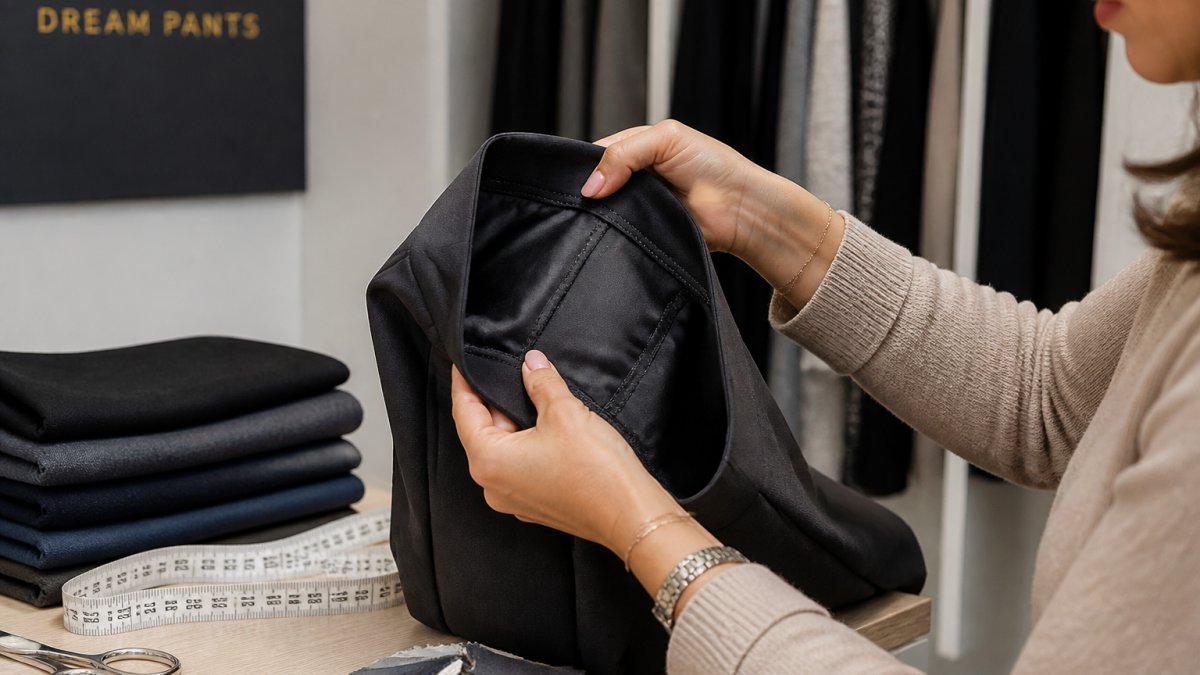
Stitch Density, Seams, and Hardware
Stitch density, stitches per inch along a seam, is one of the clearest signals of construction quality.
Run your thumb along the inner leg seam. A raw, scratchy edge means the seam wasn't finished properly; better pants are bound or flat-felled, which costs more labor and lasts longer.
Hardware is the third tell. Zippers, hooks, and belt buckles should feel solid, not tinny. Look for solid hardware, such as metal hook-and-bar closures.
Fit Consistency and Silhouette Longevity
Fit consistency means the same size fits the same way every time you order, where premium labels earn their keep. A maker with tight production control cuts every pair from the same block, so your size stays your size.
Silhouette longevity is the related question: does the pant hold its shape after ten washes, or does the knee bag out and the seat sag? For proof of which styles keep their silhouette, see our roundup of women's pants that never lose shape. Try the stretch-and-release test: pinch the thigh or knee, stretch firmly for a few seconds, release, and watch how quickly it returns to flat. Slow recovery is the earliest warning sign a pant will bag out.
The Objective Fabric Read: What to Look For on the Label
Read the fabric composition the way a buyer would, fiber content predicts behavior more than feel.
- Natural fibers (cotton, viscose, wool) bring breathability and hand-feel but vary widely in strength depending on weave density.
- Synthetic reinforcement (nylon, polyester) adds abrasion resistance and shape retention.
- Elastane/Lycra adds stretch, but heat degrades it, which is why care matters as much as construction.
Durable blends usually pair a natural-fiber base with a minority synthetic share for recovery. Pure fashion blends with a high proportion of thin synthetic fiber pill and stretch out fastest, even when they feel soft in the fitting room.
The Best Fabric for Durable Pants: What to Look For
The best fabric for durable pants balances three things: fiber content, weight, and stretch recovery. Natural fibers like cotton and viscose bring breathability and hand-feel; a small share of elastane adds stretch. What matters most is the weight of the weave and how well the fabric recovers after stretching, the two factors that separate a pair that survives three seasons from one that survives three months.
Here's how the common fabric types compare for longevity:
| Fabric type | Durability | Shape recovery | Best for |
|---|---|---|---|
| Heavy ponte knit | High | High | Cold weather, work-to-dinner |
| Cotton stretch | Medium-high | Medium | Everyday wear, ankle styles |
| Rayon-nylon-Lycra blend | Medium | High | Smooth, elongating silhouettes |
| Woven viscose blend | High | Medium-high | Structured slim fits |
| Thin synthetic blend | Low | Low | Short-term wear only |
Denim works on the same principle: heavier fabric resists abrasion and holds its line. Raw denim and selvedge get durability from dense, slow weaving, which is why they cost more and last longer. You don't need denim-grade density in a dress pant, but the logic carries over.
The Mechanisms That Actually Predict Longevity
Most fabric advice stops at "buy natural fibers." That's incomplete. Three mechanisms do most of the work:
- Weave density: tighter, denser weaves resist abrasion and hold their shape. A loose weave lets fibers shift and pill, no matter how premium the fiber.
- Fiber length and twist: longer staple fibers and tighter twist produce stronger yarn. Short-staple, loosely twisted yarn sheds and pills faster.
- Recovery memory: elastane and stretch blends return to shape only if the base fabric supports them. A stretchy fabric with poor recovery bags out at the knee and seat.
Long-lasting pants usually combine a mid-to-heavy weight fabric with a natural-fiber base and a minority synthetic share for recovery. That's why heavy ponte and dense viscose blends outlast thin synthetic blends even when the latter feel smoother at first touch.
How to Test Fabric Before You Commit
You can't run a lab test in a fitting room, but you can approximate the two most important ones:
- Abrasion resistance: rub a hidden inner seam firmly between your fingers for several seconds. If fibers fuzz or shed quickly, the weave is loose and will pill under daily wear.
- Colorfastness: ask whether the dye is garment-dyed or piece-dyed, and check the care label for a "wash separately" warning. Dark dyes that bleed in the first wash often keep bleeding, which shortens the pant's visible life even if the fabric itself holds up.
Cost-Per-Wear: The Math That Settles the Price Question
Cost-per-wear is the price of a garment divided by the number of times you wear it.
Essential Slim Ankle Pant Jupiter Cotton Stretch 28" →
Run the numbers honestly:
- Fast-fashion pair: low price, worn a handful of times before the seam splits or the shape goes
- Premium pair: higher price, worn weekly across multiple seasons
- The crossover point: the premium pair wins as soon as it outlasts two or three cheap replacements
Divide price by wears. The lower number is the better value, regardless of which tag looked cheaper at checkout, which is why an investment piece beats a wardrobe of disposable staples.
Cost-per-wear also rewards versatility: a pant that works for the office, dinner, and travel gets worn more often, pushing its cost-per-wear down further.
How to Make Pants Last Longer: Care That Protects Your Investment
You extend a garment's life most by washing it less often and gently. For the full routine, follow our step-by-step guide to caring for high-quality clothing.
Follow these care rules:
- Wash cold, never hot, to limit shrinkage and color loss
- Turn pants inside out to protect the surface finish
- Use a mesh bag for pull-on styles to reduce friction
Dark dyes can bleed in the first few washes, so wash new dark pants separately.
Watch out: the dryer is the single fastest way to destroy stretch recovery. Heat breaks down elastane, and once that happens the pant will never hold its shape again.
Best Wrinkle Resistant Travel Pants for Women Who Pack Light
Wrinkle-resistant travel pants are woven or finished to resist creasing during packing and wear. For specific pairs you can buy, browse our list of the best wrinkle resistant travel pants for women.
Our pick for packing light is the Dream Heavy-Ponte Wide Leg Pull-On Pants. Shop the Dream Heavy-Ponte Wide Leg Pull-On Pants here: Dream Heavy-Ponte Wide Leg Pull-On Pants

Premium Pants Worth Buying at Dream Pants
Premium pants are worth buying when fabric, construction, and fit consistency all justify the price.
| Style | Price | Fabric | Best for |
|---|---|---|---|
| Dream Heavy-Ponte Wide Leg Pull-On Pants | $139.00 | 67% Viscose, 29% Nylon, 4% Elastane | Cold weather, work-to-weekend |
| Essential Classic Slim Pant | $145.00 | 76% Viscose rayon, 21% Nylon, 3% Spandex | Structured slim fit, office wear |
| Essential Classic Wide-Leg Pant | $140.00 | 96% Polyester, 4% Spandex | Elongating wide-leg looks |
| Essential Slim Pant Magical Lycra 31" | $104.00 | 77% Rayon, 20% Nylon, 3% Lycra | Smooth, tummy-control fit |
| Essential Slim Ankle Pant Jupiter Cotton Stretch 28" | $92.40 | 48% Polyester, 45% Cotton, 7% Elastane | Everyday ankle-length wear |
Best for: women who want one pair that works across several occasions. Skip if: you need a specific technical outdoor fabric.


Each style is cut to a consistent size block, so once you know your size, reordering is straightforward. That consistency is what makes the cost-per-wear math work in your favor.
Find Your Next Pair at Dream Pants
The challenge with buying premium pants online is trust: will the fit hold, will the fabric match the photos, and will a return be painless if it doesn't?
Here's what you get when you shop with us:
- Free shipping on orders over $95 across Canada and the USA
- A lowest price guarantee on the brands we carry
- Consistent sizing so your next order matches your last
As one customer put it: "I can always order the exact size from my last order and am confident that they will fit... and they do!!!"
Ready to stop guessing and start investing? Get started with Dream Pants and find the pair you'll wear for seasons, not weeks.
[SHOP NOW]
Frequently Asked Questions
Do expensive pants actually last longer than cheap ones?
They often do, but the gap comes from fabric and construction rather than the price tag alone. Pants made with denser weaves, higher stitch density, and quality hardware resist pilling, seam failure, and shrinkage through repeated wash cycles. A pair that holds its shape and color after years of wear spreads its cost across far more wears than a fast-fashion pair replaced every season. The price only pays off when those quality signals are genuinely present, which is why checking seams and fabric composition before buying matters more than the label.
What is cost-per-wear and how do I calculate it for pants?
Cost-per-wear divides what you paid by the number of times you wear the item. A pair worn twice a week for two years works out to roughly 200 wears, so a higher upfront price can land at a lower cost-per-wear than a cheap pair that loses shape after ten outings. Track how often you realistically reach for a style before buying. Wardrobe staples in neutral colors and consistent fits get worn far more than trend pieces, which is where the math tips in favor of an investment piece.
How can I tell if pants are good quality in the store or online?
Check the fabric composition first: natural fibers and quality blends with a small amount of stretch tend to hold up better than high synthetic content. Look at stitch density along the inseam and waistband, feel whether the hardware is solid, and confirm the fit is consistent with your usual size. Online, read the fabric breakdown, inseam measurements, and verified buyer reviews. Dream Pants lists full composition and measurements on every product page, and its verified buyer program lets you see how other women with similar body types rated the fit.
Are expensive pants worth it if I only wear them occasionally?
It depends on the role the pants play in your wardrobe. A pair reserved for occasional events rarely earns back a high price through wear alone, so fit and comfort matter more than durability claims. Pants you wear weekly to work or travel, however, are where premium construction pays off. Focus your spending on the styles you reach for most, and choose fabrics that resist wrinkles and hold color so the occasional wear still looks sharp years later.
The real test of any pair isn't the price tag, it's how many mornings you reach for it without hesitation. Dream Pants curates premium Canadian labels with consistent sizing, free shipping on orders over $95, and 30-day postage paid returns, so you can try a pair and judge the fit for yourself. Get started with Dream Pants and build a wardrobe around pants that actually last.


Leave a comment