


Last Updated: November 21, 2026
Quick Summary
To find pants that fit, measure your waist, hips, and inseam at home and compare those numbers to each brand's size chart instead of trusting the size tag. Then try the pants on with your usual shoes and sit, stand, walk, and climb a stair before deciding, since fabric that looks clean while standing can gap or bind when you move.
- Measure your hips around the fullest part of your seat, usually about 20 cm below your waist.
- Measure inseam from the crotch seam down the inside of a pair of pants you already own.
- A back waistband that gaps when seated means the rise is too low or the waist too large.
- Buy for the widest part of your body and tailor the rest, since a tailor cannot add fabric.
- Compare garment measurements of a pair you own against the new pair before ordering online.
Table of Contents
- Start With Your Own Measurements, Not the Size Tag
- How to Measure Waist for Pants Without Guessing
- How to Measure Hips for Pants and Check Seat Room
- How to Measure Inseam for Pants and Get the Length Right
- How Pants Should Feel When You Sit, Stand, and Move
- Matching Cut and Fabric to Your Body and the Season
- Pants Alterations for a Better Fit: What Tailors Can and Cannot Fix
- Order With Confidence From Dream Pants
- Frequently Asked Questions
Start With Your Own Measurements, Not the Size Tag
Learning how to find pants that fit starts with a tape measure, not a label, and the search for pants that fit begins there too. A size 8 from one brand can match a size 12 from another, so the tag tells you almost nothing about whether a pair will sit right on your body. The fix is simple. Measure yourself once, write the numbers down, and shop from those numbers instead of a label.
The at-home measurement workflow
Grab a soft tape measure and a pair of pants you already love. Follow these steps in order:
- Wear the underwear you'd normally wear under trousers.
- Stand tall with your feet together, without sucking in.
- Measure waist, hips, and inseam (we cover each below).
- Write each number down and keep the note on your phone.
- Compare your numbers to the brand's size chart, not to your usual size.
That last step matters most. A repeatable routine beats guesswork every time.
How to Measure Waist for Pants Without Guessing
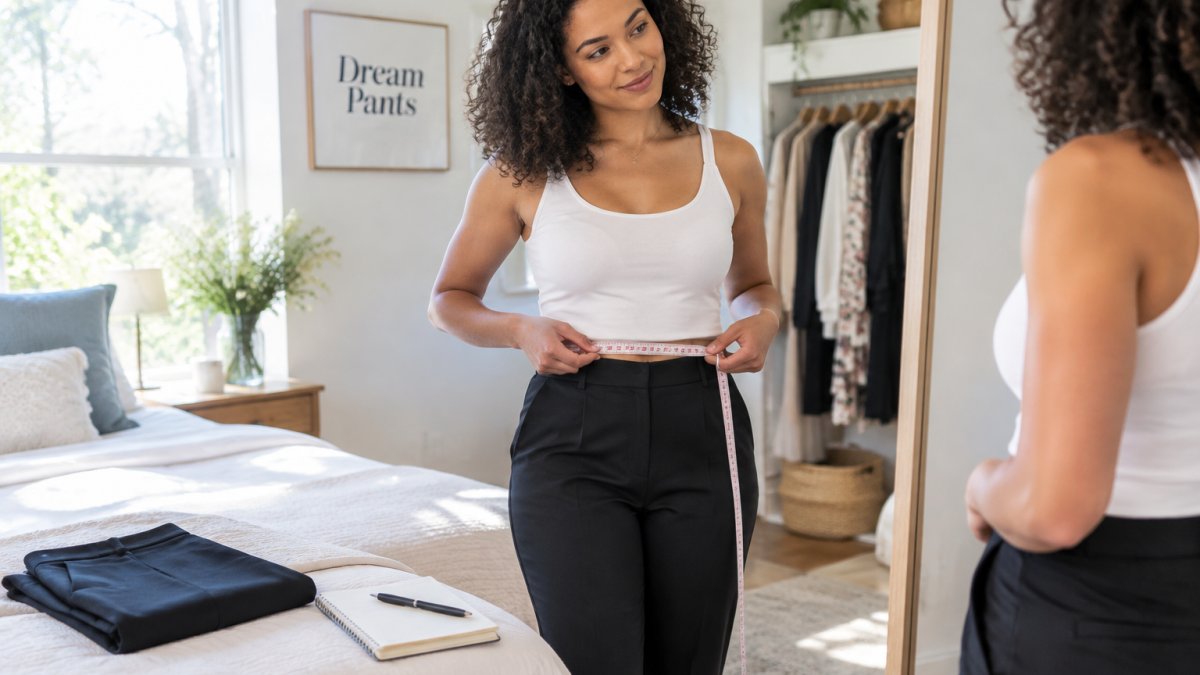
To measure your waist for pants, wrap the tape around your natural waist, the narrowest point between your ribs and hip bones. Keep the tape snug but not tight, and breathe normally. Read the number where the tape meets itself, then note it down. For a step-by-step walkthrough with photos, see our guide on how to measure waist for pants.
Where the waistband should actually sit
Most fit problems start here. A waistband that sits too low will gap at the back when you sit. One that sits too high can dig in. High-rise styles sit near the natural waist, while mid-rise styles rest a little lower on the hip. Check where the waistband of your best-fitting pair lands, then look for the same rise when you shop.
How to Measure Hips for Pants and Check Seat Room
To measure your hips for pants, stand with your feet together and run the tape around the fullest part of your seat, usually about 20 cm below your waist. Keep the tape level all the way around. This number tells you whether a pair has enough room through the seat and thigh. If your hip measurement is much larger than your waist, look for cuts with darts or a contoured waistband, which follow the curve of your body instead of pulling straight across it.
How to Measure Inseam for Pants and Get the Length Right
To measure your inseam for pants, measure from the crotch seam down the inside of your leg to the hem of a pair you already own. Use pants, not your bare leg, because the result is more accurate. If you can't measure a pair, ask someone to help you measure from your crotch to the floor while barefoot. Our ankle pants with a 28-inch inseam suit shorter frames and cropped styling.
Rise, break, and leg opening
Three details decide how a pair looks once it's on:
- Rise: where the waistband sits, from low to high.
- Break: how the hem meets your shoe, from no break to a full fold.
- Leg opening: the width at the hem, from slim to wide.
If you are unsure which rise suits your shape, our guide on how to choose the right rise for your body type breaks it down by figure.
How Pants Should Feel When You Sit, Stand, and Move
A pair that fits should feel comfortable in all three positions, not just when you stand still in the fitting room. The fastest way to judge this is a repeatable five-minute try-on check you can do at home before the tags come off. Put the pants on with the shoes you plan to wear most often, then run through this sequence in order.
- Stand and look at the front. The fly should lie flat without pulling open, and the fabric across the hips should sit smooth rather than straining into horizontal creases.
- Sit on a chair for a full minute. Check the back waistband. If it lifts away from your lower back, the rise or waist size is off. If it digs into your stomach, the waist is too small or the rise is too low for your torso.
- Cross your legs and then stand up. You should feel support, not pressure, through the thigh and seat. Fabric that grabs or restricts here usually means the cut is too slim for your proportions, not that you need a smaller size.
- Walk, climb a stair, and bend to tie a shoe. Watch for the waistband sliding down at the back or the crotch dropping. Both point to a rise that is too short or a seat that is too roomy.
- Check the hem against your shoe. With the shoes on, the hem should meet the top of the foot with the break you want, and it should not catch under your heel when you walk.
Watch out: judging fit while standing still is the most common mistake. Fabric that looks clean in the mirror can gap, pull, or bind the moment you sit, so always complete the seated and moving steps before deciding.
A symptom-to-adjustment guide
Use this table to translate what you feel into what to change. It works for any brand and any body.
| What you notice | Likely cause | What to adjust |
|---|---|---|
| Back waistband gaps when seated | Rise too low or waist too large | Try a higher rise or one size down in the waist |
| Waistband digs in when seated | Waist too small or fabric too rigid | Size up or choose a style with more stretch |
| Crotch pulls or feels tight | Rise too short or seat too small | Look for a longer rise or a curvier cut |
| Excess fabric bunches at the front | Rise too long for your torso | Try a shorter rise or a different silhouette |
| Thighs feel tight while waist fits | Cut too slim through the leg | Move to a straight or relaxed leg |
| Hem drags or catches under the heel | Inseam too long | Choose a shorter inseam or plan a hem |
| Waist fits but seat is loose | Waist-to-hip ratio mismatch | Look for darts or a contoured waistband |
Check the fabric before you commit
Fit is not only about measurements. Fabric behavior decides whether a pair keeps its shape through a long day. A fabric with good stretch recovery snaps back after you sit and stand, while a loose knit can bag out at the knee and seat by mid-afternoon. Heavier woven fabrics hold a crease and drape cleanly but give less through the hip, so they need a more generous cut.
Matching Cut and Fabric to Your Body and the Season
The right cut depends on your proportions and the time of year, and the two are linked. A silhouette that works in a heavy winter fabric can feel stiff and bulky in a light summer weave, and a summer cut that skims the body can cling in a cold-weather knit. Start with your proportions, then adjust for the season.
Match the cut to your proportions
- Straight leg: balances most body types because it follows the line of the leg without tapering or flaring. It works year-round and is the safest starting point if you are unsure.
- Wide leg: flatters taller frames and adds flow in winter fabrics, where the extra volume drapes rather than balloons. On shorter frames, keep the rise high and the hem clean so the width does not overwhelm the leg line.
- Bootcut: balances wider hips and pairs well with heels or boots because the slight flare echoes the width of the hip. It is a strong cold-weather choice when you want to wear a boot under the hem.
Curvy figures often need a little more room through the hip and thigh relative to the waist. Look for darts, a contoured waistband, or a cut described as curvy rather than straight. Our roundup of the best pants for curvy figures covers cuts that actually fit.
Adjust for the season
In cooler months, a heavier fabric with a wide or straight leg drapes well over boots and holds its shape through a long day. Look for fabrics with enough weight to hang cleanly and enough stretch recovery to avoid bagging at the knee. In warmer weather, a lighter ankle-length style feels fresher and shows off your shoes, but check that the weave is opaque and that the fabric does not cling after a few hours of wear.
Use garment measurements, not just the size chart
Size charts describe body measurements, but the pants themselves have their own measurements. Before you order, compare the waist, hip, rise, and inseam of a pair you already own against the garment measurements listed for the new pair.
Watch out: a size chart that matches your waist does not guarantee the seat and thigh will fit. Always compare the hip and thigh measurements too, because a pair can match your waist and still pull across the seat.
Pants Alterations for a Better Fit: What Tailors Can and Cannot Fix
A tailor can shorten a hem, take in a waist, or slim a leg. Those are quick fixes. What a tailor cannot do is add fabric where there isn't enough, so a pair that is too tight through the hip or seat will stay tight. Check the seam allowance before you buy if you plan to let a waist out.
Order With Confidence From Dream Pants
Fit is easier when the brand does its part. Dream Pants carries premium Canadian labels such as Lisette L, Sympli, Joseph Ribkoff, Frank Lyman, French Dressing Jeans, Dolcezza, and Alison Sheri.
Here is what shopping with us includes:
- Free shipping on orders $95+ in Canada and the USA
- 30-day postage paid returns
- We pay the duties
Ready to put your measurements to work? Shop our straight and wide leg pants with a 32-inch inseam and find your pair.
Finding pants that fit gets much easier once you stop trusting the size tag and start trusting your tape measure.
Frequently Asked Questions
How do I find pants that actually fit when I shop online?
Measure your natural waist, fullest hip, and inseam with a soft tape, then compare those numbers to the garment measurements on each product page rather than the size label. Check the rise and leg opening too, since two pants in the same size can sit very differently. Order from a retailer with clear sizing and a real returns policy, try the pants on with the shoes you plan to wear, and sit down before you cut any tags.
Is a 32-inch waist actually 32 inches in pants?
Not always. A labeled waist size is a nominal number, and actual garment measurements often differ by an inch or more depending on the brand, the fabric stretch, and where the waistband sits. That is why reading the garment measurement is more reliable than trusting the tag. Measure a pair you already own that fits well, flat across the waistband, double it, and compare that number to the size chart before you buy.
What should I do if pants fit my hips but not my waist?
A gap at the back waistband usually means the rise or the waist-to-hip ratio is wrong for you, not that you need a smaller size. Try a style with a contoured waistband, front darts, or a higher rise, which follows the curve of your body instead of sitting straight. If the hip fit is right and the gap is small, a tailor can take in the center back seam. Never size down to close a waist gap, because the hips and seat will become too tight.
How long should pants be, and when are alterations worth it?
Length depends on the break you want: a full break rests on the shoe, a slight break just touches it, and a cropped hem shows the ankle. Stand in the shoes you will actually wear and check where the hem lands. Hemming is the cheapest and most reliable alteration, so buy for the waist, hips, and rise first, then shorten the leg. Taking in a waist or narrowing a leg costs more, so only tailor pants whose seat and thigh already fit well.


Leave a comment