


Last Updated: November 2, 2026
Quick Summary
To identify authentic designer apparel, start with the garment itself: check the fabric, stitching, and finishing before you judge the logo. Then examine the labels and compare the piece with a verified genuine example from the same brand, season, and category.
- Check the inside seams and lining, since many fakes look fine outside but show rushed stitching within.
- Treat labels as one piece of evidence, verifying them against official brand examples rather than a single checklist.
- Compare the suspect piece side by side with a known authentic item and note differences in fabric, stitching, and hardware.
- When buying secondhand or online, vet the seller's history and request close-up photos of stitching, labels, and hardware.
- Pay through a method offering dispute resolution and save screenshots of listings and payment terms as evidence.
Table of Contents
- How to Spot Fake Designer Clothes Before You Look at Labels
- Step 1: Inspect the Fabric and Overall Construction
- Step 2: Read the Designer Clothing Labels and Tags
- Step 3: Compare the Piece With a Verified Authentic Example
- How to Authenticate Designer Clothing You Buy Secondhand or Online
- Finding Authentic Designer Apparel Online Safely
- Where Visual Checks Stop and What to Do Next
- Shop Authentic Pieces From Dream Pants This Season
- Frequently Asked Questions
How to Spot Fake Designer Clothes Before You Look at Labels
Shopping for authentic designer apparel is more confusing than it used to be. Counterfeits are often convincing at a glance, so a logo alone tells you very little. The smartest buyers check the garment itself first, then the labels, then the seller.
Most fakes give themselves away in the same few places: the fabric, the stitching, and the finishing. Start there. You will catch far more problems this way than by squinting at a logo.
Here is a simple habit to build: handle the piece before you judge it. Good tailoring has a feel that cheap copies rarely match.
Step 1: Inspect the Fabric and Overall Construction
Begin with the material. Authentic designer apparel is made from fabric that feels consistent, balanced, and well finished.
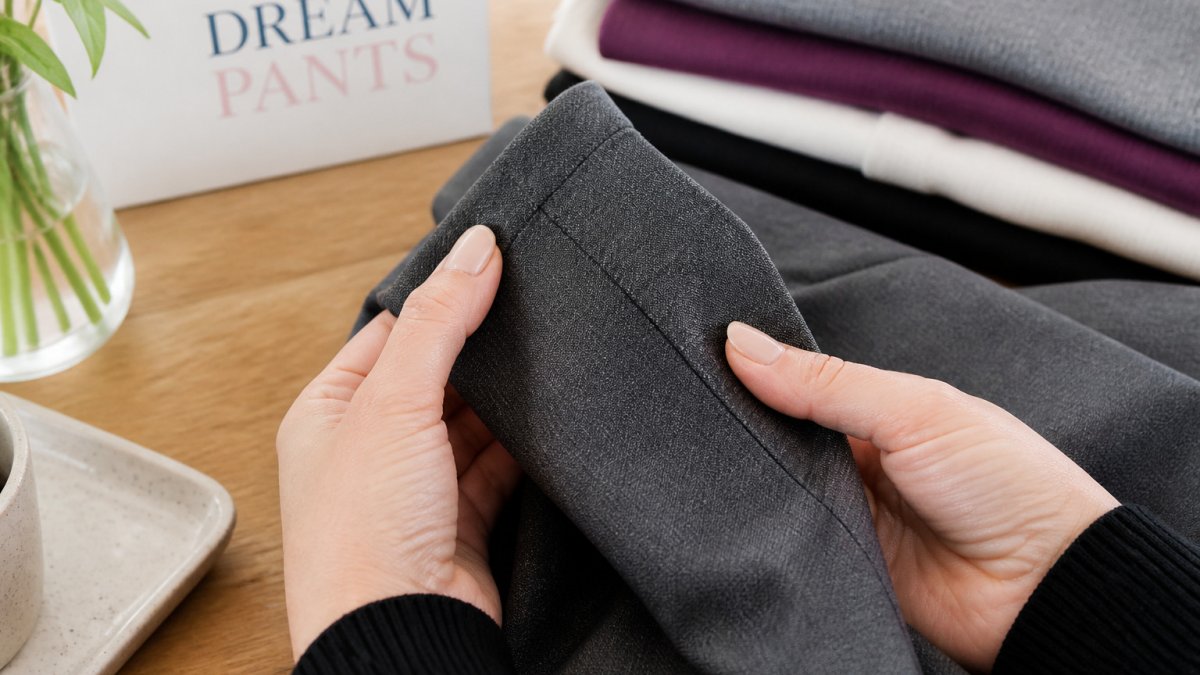
Look for these signs of quality:
- Even weave or knit with no loose threads or pilling
- Colour that looks uniform across the whole garment
- Pattern lines that match at the seams
- Substantial weight that fits the fabric type
Next, look at the overall shape. A well-made garment lies flat, hangs cleanly, and keeps its line when you move. Cheap copies often twist, pucker, or sag in odd places.
!Close-up of hands gently examining the fabric weave and seam of a tailored wool trouser on a bright wooden table
Checking Stitching, Seams and Finishing
Stitching tells you a lot. Turn the garment inside out and examine the seams closely.
- Stitches should be straight, tight, and evenly spaced
- Seam allowances should be neat, not frayed or raw
- Hems should be sewn with care, not glued or loosely tacked
- Edges should be finished cleanly, with no stray threads
Watch out: Many fakes look fine from the outside but show rushed, uneven stitching on the inside. Always check the back of the seams and the lining.
Step 2: Read the Designer Clothing Labels and Tags
Labels matter, but treat them as one piece of evidence, not proof. Counterfeiters copy labels carefully, so a tag that looks right does not settle the question.
Authentication cues vary by brand, era, and garment type. A label that is correct for a 2015 jacket may be wrong for a 2024 version of the same style, and a knitwear label often differs from a tailored jacket label from the same house. Before you judge a tag, confirm what the label should look like for that specific brand, season, and category.
Check these details:
- Spelling and font: Look for typos, uneven lettering, or fonts that do not match official examples. Font weight and spacing matter as much as the words themselves.
- Placement: Labels should be sewn in neatly and in the expected spot for that brand. Placement can shift between seasons, so verify against a known example from the same year.
- Care and content information: Fiber content and care instructions should be clear, accurate, and well printed. Multiple language blocks should be consistent in font and alignment.
- Serial or product codes: Some brands use codes that can be checked against their own records. Use only the brand's official channels to verify them. Do not trust a code lookup site run by a third party.
- Construction of the label itself: Genuine labels are usually woven or printed with clean edges, secure stitching, and no loose threads. A label that feels stiff, shiny, or hastily attached is a warning sign.
How to find reliable reference examples without treating one checklist as universal:
- Use the brand's own website or official lookbook for the same season and garment type.
- Compare with a verified authentic piece from a trusted retailer or a reputable authentication community.
- Ask the brand's customer service to confirm label details when the item is high value.
- Cross-check multiple sources. If two credible references disagree, do not rely on the label alone.
Compare the label to a verified example from the brand's own website or a trusted retailer. Do not rely on photos from the seller alone.
Step 3: Compare the Piece With a Verified Authentic Example
The fastest way to spot a fake in authentic designer apparel is to compare it with a known genuine item. Find an authentic piece from the same brand, season, and category, then compare them side by side.
Check the same features on both:
- Fabric weight and feel
- Stitch density and seam finishing
- Label design and placement
- Hardware, zippers, and buttons
- Packaging and accessories
| Feature | Authentic Piece | Suspect Piece |
|---|---|---|
| Fabric feel | Smooth, balanced weight | Thin, stiff, or uneven |
| Stitching | Tight and even | Loose or irregular |
| Label | Crisp, correctly placed | Blurry, misspelled, or off-centre |
| Hardware | Solid, smooth action | Light, rattling, or rough |
If the two pieces differ in several of these areas at once, treat the suspect piece with real caution.
How to Authenticate Designer Clothing You Buy Secondhand or Online
Secondhand and online buying carry more risk, because you cannot handle the piece before you pay. Compare sellers by buying from a trusted retailer instead of relying on a single listing photo. The strongest protection is not a single photo check, it is managing the purchase before money changes hands.
Vet the seller before the item. Look at seller history, not just the listing. Check how long the account has been active, read reviews from past buyers, and look for a consistent inventory that matches the seller's stated expertise. A seller who suddenly lists many high-value designer pieces with no history is a warning sign.
Ask for provenance and documentation. Request close-up photos of the stitching, inside labels, hardware, and any codes. Ask about the item's origin, receipts, dust bags, and any original packaging. A cautious seller will answer these requests willingly. Be wary of anyone who refuses, offers only stock photos, or pressures you to move the sale off-platform.
Confirm the return policy and payment protection before you buy. A clear return window and buyer protection are your real safety net. Pay through a method that offers dispute resolution, and keep the transaction on the platform where possible. Avoid direct transfers or gift payments that leave you with no recourse.
Use photos to screen, not to certify. Photo checks have limits. Even a careful look at pictures cannot confirm fabric feel or fine stitching. Use photos to screen out obvious problems, then decide whether the seller earns your trust.
Know when to walk away. If the price is far below the market for that brand and category, or the seller cannot explain the item's history, the risk is not worth it. A genuine piece at a fair price is a better outcome than a bargain that turns into a dispute.
Finding Authentic Designer Apparel Online Safely
Buying authentic designer apparel from a trusted, established retailer lowers your risk the most. Look for a retailer with a clear return policy, real customer reviews, and transparent product details.
Before you order, check that:
- The retailer's contact details and policies are easy to find
- Product photos show the actual garment, not only marketing images
- Sizing and fabric details are listed clearly
- Reviews come from verified buyers
Dream Pants, for example, offers consistent sizing and fast delivery, which helps when you are ordering without trying items on.
Where Visual Checks Stop and What to Do Next
No inspection method is perfect. Even skilled buyers can be fooled by a high-quality counterfeit or by an authentic piece that has been altered or repaired. Vintage garments also age in ways that can confuse even careful checks.
If you suspect a fake after purchase:
- Contact the seller or retailer in writing and keep all records
- Ask for a refund or return within the stated policy window
- Report the listing to the marketplace, if you bought through one
- Consider a professional authentication service for high-value items
Keep your receipts, photos, and messages. They are your best evidence if you need to dispute a purchase.
Shop Authentic Pieces From Dream Pants This Season
Fall is a great time to refresh your wardrobe with timeless, well-made authentic designer apparel. Dream Pants carries premium women's apparel from Lisette L, Sympli, Joseph Ribkoff, Frank Lyman, French Dressing Jeans, Dolcezza, and Alison Sheri, with free shipping on orders over $95 in Canada and the USA and 30-day postage-paid returns.
Browse the current collections and choose pieces that fit your everyday life.
Frequently Asked Questions
How do you spot fake designer clothes?
Start with the garment itself before you look at branding. Check the fabric weight and feel, the evenness of stitching, the alignment of prints or patterns at seams, and the quality of zippers and buttons. Authentic designer pieces usually show consistent, tight construction and clean finishing inside as well as outside. Compare these details against a verified example from the same brand and season whenever you can, since one red flag is a reason to look more closely rather than proof on its own.
Can a clothing label prove that a designer item is authentic?
No. Labels and tags can be copied, so a label that looks right is not proof by itself. Check that the label's font, stitching, placement and care information match what the brand used for that line and period, and look at the overall construction too. Treat the label as one part of a wider inspection, and be cautious if the rest of the garment does not match the quality the label implies.
How can you verify designer apparel when shopping online?
Ask the seller for multiple clear photos of the front, back, labels, stitching and any hardware, and request close-ups of details rather than styled shots. Review the seller's history and return policy, and buy from authorized retailers where possible. If a price looks unrealistically low for the brand and condition, or the seller avoids answering detail questions, step back. Keep records of your purchase in case you need to dispute it.
What should you do if you are unsure whether designer clothing is genuine?
Pause before wearing or reselling the piece. Compare it closely with a verified authentic example, and ask a reputable authentication service or the brand's customer care team for their view. If the item came from a secondhand or online seller, contact the seller and the platform where you bought it, and document your concerns with photos. Visual checks have limits, so an expert review is worth considering for expensive purchases.


Leave a comment