


Table of Contents
- Why Accurate Pants Measurements Matter
- What You'll Need to Get Started
- How to Measure Waist for Pants
- How to Measure Inseam for Pants
- How to Measure Pants Size with a Tape Measure
- Understanding Women's Pants Size Chart Measurements
- Common Measurement Mistakes to Avoid
- Body Measurements vs. Pants Measurements
- Frequently Asked Questions
Last Updated: October 7, 2026
Why Accurate Pants Measurements Matter
Getting the right fit starts with knowing your actual measurements. When you measure pants size accurately, you eliminate the guesswork that leads to returns and frustration.
A single inch off on your inseam can make pants unwearable, and your waist measurement affects comfort all day.
Most people skip this step or guess based on their last purchase, that's where sizing problems start.
What You'll Need to Get Started
You don't need much to measure pants size accurately. A soft, flexible tape measure is essential, not a rigid ruler.
Here's your complete checklist:
- Soft measuring tape (fabric or plastic, not metal)
- A pair of well-fitting pants you already own (as a reference)
- A mirror (optional but helpful)
No tape measure? Any flexible ruler works, or use string measured against a hard ruler, though a proper tape measure is faster and more accurate.
Keep your measurements written down. When you order from Dream Pants, having these numbers ready makes the process seamless, our team can help you find the exact fit you need from brands like Lisette L, Sympli, and Joseph Ribkoff.

How to Measure Waist for Pants
Your waist measurement is the foundation of pants sizing: the circumference around your natural waist, not your hip bones.
Find your natural waist by bending slightly to one side, the crease that forms is where your waist naturally folds.
Measure all the way around, keeping the tape level, don't let it dip in back or ride up in front.
The tape should feel like a comfortable belt, not a squeeze.
How to Measure Inseam for Pants
Your inseam is the length of the inner seam of your pants leg, from crotch to hem. It determines whether your pants hit at your ankle, your shoe, or somewhere in between.
Measuring Inseam on Your Body
Stand on a flat surface wearing the shoes you'll typically pair with your new pants, heels add height. Have someone measure from the inner thigh down to your ankle bone, keeping the tape straight, not angled.
Measuring alone? Wear your typical shoes, measure from crotch to floor, then subtract half an inch.
Write down your inseam. Most women's inseams range from 26 to 34 inches, varying by height and proportions.
Measuring Inseam on a Pair of Pants
You can also measure an existing pair that fits well. Lay the pants flat, find the inner seam from crotch to hem, and measure straight down. That's your inseam.
This works best with pants you already love, it removes guesswork about heel height or posture.
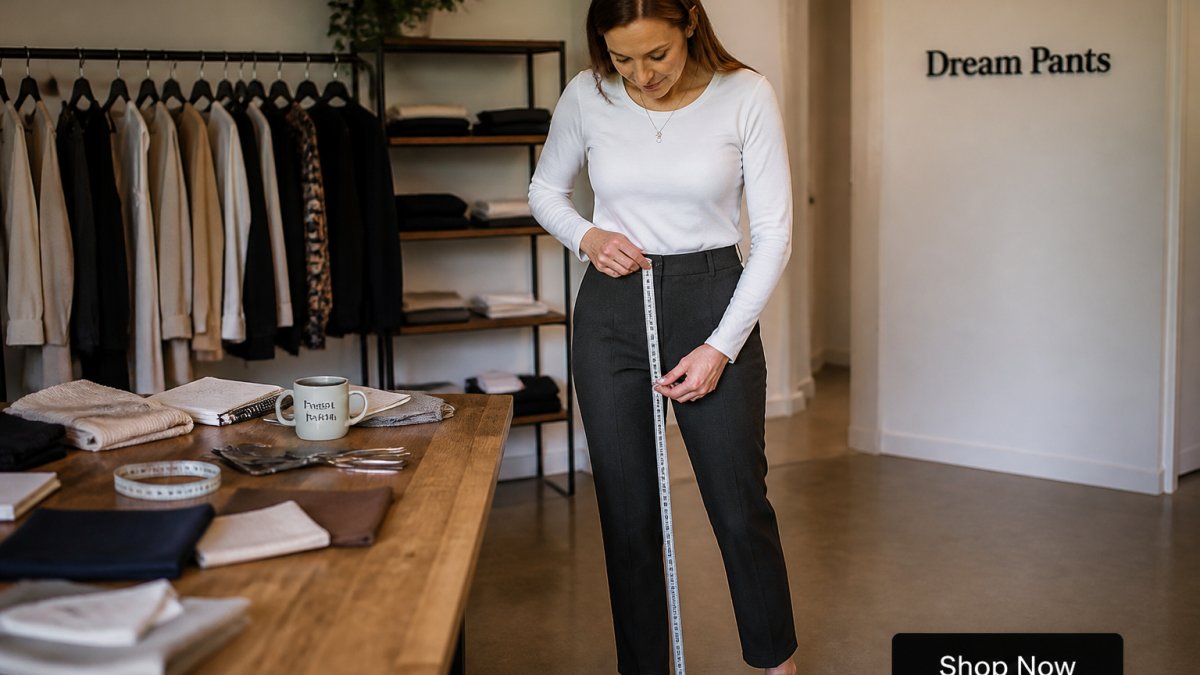
How to Measure Pants Size with a Tape Measure
Waist and inseam get you close, but a full pants size is built from five measurements: waist, rise, inseam, knee opening, and leg opening. Here is the complete procedure, with the exact landmark for each number so your results are repeatable.
The five landmarks you need to know
Before you touch the tape, agree on where each measurement starts and ends. Ambiguous reference points are the number-one cause of sizing errors.
- Waist: the circumference of the waistband, measured at the top edge, with the front and back waistbands aligned.
- Rise: the vertical distance from the top of the front waistband to the crotch seam where the front and back leg seams meet.
- Inseam: the vertical distance from the crotch seam to the bottom of the hem, along the inside of the leg.
Step-by-step: measuring a pair of pants laid flat
Use a pair of pants you already love. This reference-garment method removes guesswork about heel height, posture, and fabric drape.
- Button and zip the pants. Lay them flat and smooth the fabric so no wrinkles pull the tape off-line.
- Align the seams. Match the front and back rise seams so the waistband sits level, a twisted waistband means wrong waist and rise numbers.
- Measure the waist. Hook the tape at one side-seam edge of the waistband, pull straight across to the other, then double the number for the waistband circumference.
- Measure the rise. Place the tape at the top of the front waistband and drop it straight down to the crotch seam, keeping it vertical.
- Measure the inseam. From the crotch seam where the leg seams meet, run the tape straight down the inside of the leg to the hem, don't follow the leg's curve.
- Measure the knee opening. Fold the leg so the knee crease shows, then measure straight across at that crease.
- Measure the leg opening. Measure straight across the hem from side seam to side seam.
- Repeat every number twice. If readings match, record it; if they differ, take a third and use the middle value.
Step-by-step: measuring your body
Body measurements tell you what size to look for. Garment measurements tell you whether a specific pair will fit. You need both.
- Stand on a flat floor in thin clothing, feet together, weight even.
- Find your natural waist by bending slightly to one side, the crease that forms is your natural waist, not your hip bones or belly button.
- Wrap the tape around your natural waist, level all the way around, snug enough to slip one finger under.
- Measure your hip at the fullest point, usually 7-9 inches below the natural waist.
- Measure your inseam from crotch to ankle bone, or to the floor for a full-length break. Have someone help if you can, self-measuring tends to add length.
- Measure your rise from your natural waist straight down to the crotch.
Reading the numbers
| Measurement | What it tells you | Typical women's range |
|---|---|---|
| Waist | Circumference at natural waist | 24-40 inches |
| Hip | Circumference at fullest point | 34-48 inches |
| Rise | Waistband to crotch seam | 8-12 inches |
| Inseam | Crotch to hem | 26-34 inches |
| Knee opening | Width across the knee | 7-10 inches |
| Leg opening | Width across the hem | 6-9 inches |
Once you have these six numbers, you can compare any pair of pants, online or in-store, against a garment you already trust. That's the point of measuring: not memorizing a size label, but building a personal reference you can reuse for every purchase.
For fall, look for mid-to-high rise silhouettes in ponte and stretch fabrics. Brands like Lisette L, Sympli, Joseph Ribkoff, and Frank Lyman offer consistent rise and inseam specs, so the numbers you record this week will still match the pair you order next month.
Understanding Women's Pants Size Chart Measurements
A size chart is not a label translator, it's a set of garment measurements, and your job is to match your body numbers to the chart's numbers, not the size name. Here's how, in four steps.
Essentials Slim Ankle Pants, Mila Stretch →
Step 1: Know which numbers the chart is giving you
Most women's pants charts list one of two things, and they're not interchangeable:
- Body measurements, the chart tells you what body waist, hip, and inseam the size is designed for. You compare your body numbers directly.
- Garment measurements, the chart tells you the actual flat-lay measurements of the finished pants. You compare these to a pair you already own, not to your body.
If the chart doesn't say which it is, assume body measurements for waist and hip, and garment measurements for rise, knee, and leg opening. When in doubt, ask customer service, a two-minute email saves a return.
Step 2: Match your primary measurement first
Find your waist measurement in the chart's waist column, that row is your starting size. Then check the hip column against your hip measurement. If they point to different sizes, follow the hip for pants at or below the natural waist, and the waist for high-rise styles. The waistband is hardest to alter, so it usually wins the tiebreak.
Step 3: Check the secondary measurements
Once you have a candidate size, verify it against your reference garment:
- Rise: if the chart's rise is more than 1 inch shorter than your favorite pair, expect the pants to sit lower.
- Inseam: if the chart's inseam is more than 1 inch off, plan for a hem or a cuff.
- Leg opening: a 1-inch difference here changes the silhouette noticeably, a slim ankle becomes a straight leg.
Step 4: Account for ease and fabric
This is the part most size charts don't tell you, and where fit is won or lost.

- Woven, no stretch: you need roughly 1 inch of ease at the waist and 1-2 inches at the hip for sitting and movement. If the chart's garment waist equals your body waist exactly, the pants will feel tight.
- Ponte, ponte de roma, or 4-way stretch: you can size down between sizes because the fabric recovers. Sympli and Lisette L ponte styles are cut this way.
- High-rise, wide-leg, or pleated: these carry extra volume through hip and thigh, so match your waist and let the leg do its own thing.
Handling brand-to-brand variation
Two brands can both label a pair 'size 8' and cut them 1-2 inches apart at the waist. That's normal, and it's why your measurement list matters more than the tag. A practical routine:
- Keep your six measurements (waist, hip, rise, inseam, knee, leg opening) saved in your phone.
- Before buying from a new brand, compare your numbers to its size chart, not to your usual size.
- If the chart is missing a measurement you rely on, check the product page for a fit note or contact the brand.
- After the pants arrive, measure them flat and compare to the chart. If they match the chart but not your body, the issue is fit preference, not sizing, and you now know which measurement to adjust next time.
At Dream Pants, our selection is built around brands with consistent, well-documented sizing, Lisette L, Sympli, Joseph Ribkoff, and Frank Lyman, so once you have your numbers, each product page's chart tells you exactly what you're getting. That consistency means fewer surprises, fewer returns, and pants that fit the first time.
Common Measurement Mistakes to Avoid
Most measurement errors happen the same way.
Measuring too tight. Your tape measure should be snug, not strangling.
Letting the tape drift. Keep your measuring tape level and straight.
Measuring over thick clothing. Wear thin layers, a bulky sweater changes your measurements.
Rounding inconsistently. If your waist measures 29.5 inches, decide whether you round up or down, then stick with it.
Measuring only once. Measure twice and compare.
Body Measurements vs. Pants Measurements
Your body measurements and your pants' measurements are related but not identical.
Pants are cut slightly larger than body measurements to allow for movement and comfort.
When shopping, compare your body measurements to the pants measurements on the size chart.
Rise and inseam work similarly.
Getting the right fit starts with knowing how to measure pants size accurately.
At Dream Pants, we make this process even easier.
SHOP NOW and discover pants that fit your body perfectly. Start with our Essentials Slim Ankle Pants in Mila Stretch for a versatile everyday option, or explore our Dream Slim Ankle Millennium Pants with tummy control for a flattering fit.

Frequently Asked Questions
How do you measure your waist for pants accurately?
Stand in front of a mirror wearing minimal clothing. Locate your natural waist (the smallest part of your torso, typically above your belly button). Wrap a soft tape measure snugly around this point, not too tight, not too loose. Keep the tape parallel to the ground and note the measurement in inches. For the most accurate reading, measure twice and average the results. This body measurement helps you select the correct waist size when using a women's pants size chart.
Should you measure your body or a pair of pants?
Measure both for different purposes. Body measurements tell you your true size and help you understand how garments should fit. Measuring an existing pair of pants you love helps you find similar fits in new styles. Lay the pants flat on a clean surface and measure key points: waist across the front (fold in half and measure one side, then double it), inseam from the crotch seam to the hem, and rise from the top of the waistband to the crotch. Comparing your body measurements to measurements taken from pants shows why vanity sizing varies between brands.
What is my pant length if I'm 5'4"?
There's no single answer, inseam depends on your specific leg length, not just height. Two people who are 5'4" may have different inseams due to torso-to-leg proportions. The best approach is to measure your own inseam: stand barefoot, have someone measure from your inner thigh (crotch point) down to your ankle bone, or measure an existing pair of pants you love. Most women around 5'4" wear inseams between 27-29 inches, but your personal measurement is what matters for proper fit.
How do you interpret a women's pants size chart measurements?
A women's pants size chart typically lists waist, inseam, rise, and knee opening measurements for each size. Match your body measurements to the chart row that fits most of your key points, usually waist and inseam are prioritized. Keep in mind that vanity sizing means a size 6 at one brand may differ from another. Dream Pants carries premium Canadian brands like Lisette L and Sympli, each with consistent sizing within their own collections. Our customer reviews confirm that ordering the same size from previous purchases ensures reliable fit, and our 30-day postage-paid returns make it easy to exchange if needed.


Leave a comment