


Table of Contents
- What You'll Need Before You Measure
- How to Measure Waist for Pants: Step-by-Step
- How to Measure Hips for Pants
- How to Measure Inseam for Pants
- Women's Pants Size Chart by Brand: Why Numbers Vary
- Matching Your Waist Measurement to the Right Rise and Fit
- Common Mistakes That Throw Off Your Waist Measurement
- Frequently Asked Questions
Last Updated: September 28, 2026
What You'll Need Before You Measure
Learning how to measure waist for pants starts with two tools and one habit: a flexible measuring tape and a mirror.
Here's your short checklist:
- Flexible measuring tape (cloth or retractable, not a metal carpenter's tape)
- A full-length mirror so the tape stays level all the way around
- Fitted clothing or thin leggings, never jeans or a chunky sweater
- A pen and paper, or your phone's notes app
- A friend, if you can borrow one, since a second set of eyes keeps the tape level
Measure at the end of the day, not first thing in the morning, your waistline shifts slightly after meals, and you want the number that reflects your normal shape.
How to Measure Waist for Pants: Step-by-Step
The whole process takes about two minutes. Follow these steps in order for a number you can trust every time you shop.
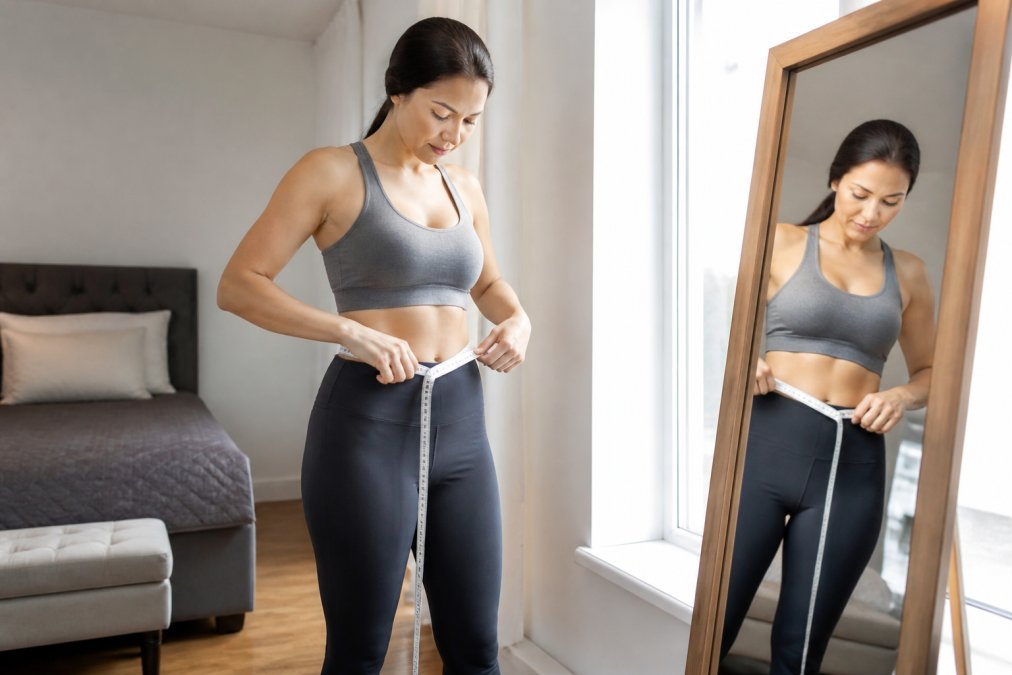
Find Your Natural Waistline
Your natural waistline is the narrowest point of your torso, usually just above your belly button and below your ribcage. Bend sideways at the waist, the crease that forms is your natural waist.
Don't confuse it with where you wear your jeans: low-rise pants sit below this line, high-waist styles at or above it. Your natural waist is the fixed landmark everything else is measured against.
Stand tall and relaxed, and exhale normally, don't suck in or puff out.
Place the Tape and Read the Number
Wrap the tape around your natural waist, keeping it level with the floor all the way around. Check the mirror to confirm it isn't dipping at the back.
How to Measure Hips for Pants
Your hip measurement is the widest point of your lower body, and it matters as much as your waist, many brands size by hip first, especially for curvy fits.
How to Measure Inseam for Pants
Inseam is the distance from the crotch seam to the hem, and it decides where your pants break at the ankle. Get it wrong and even a perfect waist fit looks off.
You have two options:
- Measure pants you already own. Lay a pair flat, then measure from the crotch seam straight down the inner leg to the hem. This is the most accurate method.
- Measure your body. Stand against a wall without shoes. Have a friend measure from your crotch down to where you want the hem to fall, usually just above the floor.
Women's Pants Size Chart by Brand: Why Numbers Vary
A size 10 at one brand is not a size 10 at another. There is no enforced standard for women's sizing: each brand builds its own fit model, and those models change over time. The fix is not to memorize a chart, it's to learn how to read any chart against your own numbers.
Why the Same Number Fits Differently
| What Varies | Why It Matters | What To Do |
|---|---|---|
| Vanity sizing | A "10" today may equal an old "12" | Trust measurements, not labels |
| Rise style | Low, mid, and high waist sit differently | Match rise to your natural waist number |
| Fabric stretch | Stretch cotton relaxes after wear | Size down if fabric has stretch |
| Brand fit model | Some cut for straighter shapes, some curvy | Check each brand's own size guide |
| Regional sizing | Canadian and US charts can differ | Confirm the chart's origin |
How to Convert Your Waist Measurement Into a Size
Most women's pants size charts list a body measurement range, not the finished garment measurement. If a chart says a size 8 fits a 28-inch waist, that 28 inches is your body, not the waistband, the waistband is usually cut slightly smaller so the fabric can stretch to fit.
Here is the conversion process that works across brands:
- Find the brand's body measurement chart, not the garment spec sheet. Look for the words "fits waist" or "body measurement."
- Compare your natural waist number to the range, not the single number. If your waist is 29.5 inches and the size 8 range is 28-30 inches, you are a size 8 in that chart.
- Cross-check against your hip measurement. If your waist says size 8 but your hip says size 10, most brands cut for the hip. Size up and plan to have the waist taken in.
- Check the rise. A low-rise pant sits 2-3 inches below your natural waist, where your body is wider. Add 1-2 inches to your waist measurement when shopping low-rise.
- Check the fabric. If the chart notes elastane, spandex, or "comfort stretch," the waistband will relax with wear. Stay at the lower end of your size range.
The Vanity Sizing Trap
Vanity sizing is the practice of labeling a larger garment with a smaller number to make shoppers feel better. It is not new, and it is not going away: a size 6 in one brand may measure 30 inches at the waist, while a size 6 in another measures 26 inches.
A Quick Note on Men's vs. Women's Charts
Men's pants are usually sold by waist and inseam in inches (for example, 32×30), while women's pants are sold by a single number (0, 2, 4, and so on) that varies by brand. Shopping men's? Measure your natural waist and round to the nearest even inch. Shopping women's? Use the range-matching method above.
Matching Your Waist Measurement to the Right Rise and Fit
Your waist number only solves half the puzzle, the rise and fit decide how that number translates to comfort.
Rise is where the waistband sits on your body:
- Low rise sits below your natural waist, often two to three inches down
- Mid rise rests near or just below your natural waist
- High waist sits at or above your natural waistline
Common Mistakes That Throw Off Your Waist Measurement
Small errors add up to big fit problems. Here are the ones we see most often, plus how to adjust your method if your body shape doesn't match the "standard" figure most guides assume.
The Standard Mistakes
- Measuring over thick clothing. Jeans and sweaters add bulk. Measure against thin fabric or skin.
- Pulling the tape too tight. A tight tape reads smaller than reality. Keep it snug, not squeezing.
- Letting the tape tilt. A tape that dips at the back adds inches. Use a mirror to keep it level.
- Measuring the wrong spot. The waistband of your favorite jeans is not your natural waistline.
- Skipping the hip measurement. Waist alone won't tell you if pants fit through the seat and thighs.
- Forgetting fabric stretch. Stretch cotton relaxes with wear, so a snug fit may loosen by day's end.
- Relying on an old number. Body measurements shift over time. Re-measure before each big purchase.
How Body Shape Changes the Measurement
Most guides give one set of instructions and assume every body follows it. Your shape determines where your natural waist sits, how much your hip measurement matters, and which fit problems you're most likely to hit.
Re-Measure Before Every Major Purchase
Your body changes with weight, muscle, pregnancy, and age, so a measurement from two years ago may be off by an inch or more. Note the date of your last measurement and re-measure if it has been more than six months or your weight has changed by more than five pounds.
Frequently Asked Questions
Where exactly should I measure my waist for pants?
Measure at your natural waistline, the narrowest point of your torso, usually just above your belly button and below your ribcage. Bend sideways and the crease that forms marks your natural waist. Keep the flexible measuring tape level all the way around and snug against your body without pulling tight. This number is what most women's pants size charts by brand use as their starting point, so accuracy here matters more than anywhere else.
Should I measure my waist over or under my clothes?
Measure over thin clothing or bare skin, never over bulky layers like sweaters or thick denim. A fitted t-shirt or leggings won't distort the reading, but a chunky belt or loose fabric will. If you're between sizes, measure twice: once bare and once over the type of underwear you'd normally wear with the pants. Use the larger number when matching to a size guide, since a snug fit is easier to tailor than one that's too tight.
How do I know if I'm a size small, medium, or large based on my waist?
Letter sizing varies by brand, so always check the specific women's pants size chart by brand rather than assuming a universal S/M/L. As a rough guide, a waist of 66-71 cm (26-28 inches) often lands at small, 71-79 cm (28-31 inches) at medium, and 79-86 cm (31-34 inches) at large. Use your hip measurement alongside your waist, since pants must clear your hips to fit properly.
Does a 34 waist mean 34 inches?
Not always. A 34 waist on a label typically refers to the garment's waistband measurement, not your body measurement. Many brands add 2-5 cm (1-2 inches) of ease so the pants sit comfortably. Your body waist might be 81 cm (32 inches) while you wear a 34. This is why knowing how to measure waist for pants yourself, then comparing to that brand's size guide, gives a far more reliable fit than trusting the number on the tag.


Leave a comment